
Waste heat, artificial intelligence and new directives promote energy efficiency
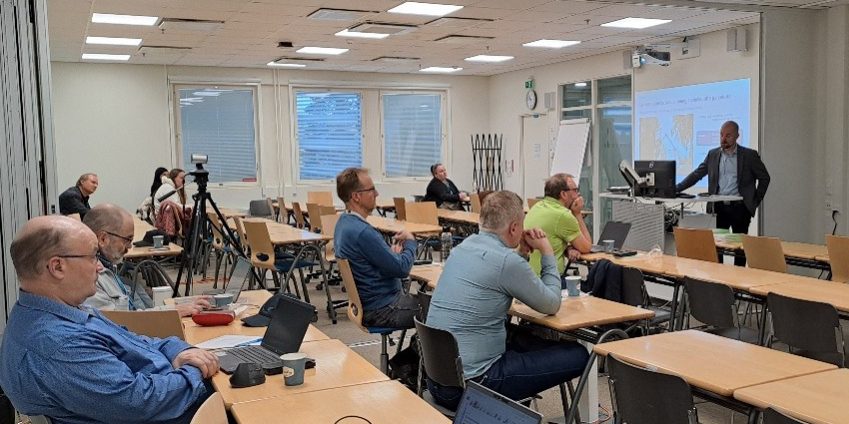
The closing seminar for the Finnish part of the Easy Energy project—funded by the European Union’s Interreg BSR programme—was held in Pori on October 8, 2026. Principal Lecturer Sirpa Sandelin opened the event by outlining the project's objectives and results. Principal Lecturer Jarkko Heinonen from Satakunta University of Applied Sciences (SAMK) gave a presentation on the educational aspect; he briefly introduced SAMK, reviewed the university's key strategies, and discussed upcoming training courses, specifically highlighting those related to building energy efficiency. The content of the courses covers topics such as energy audits, energy performance certificates, climate assessments, and renovation passports. In the future, it will also be possible to participate in all these courses via the Open University of Applied Sciences.
Current themes in building energy efficiency training include the renovation passport, long-term renovation plans for improving energy efficiency, and building-integrated battery systems. Also relevant to Satakunta University of Applied Sciences is BattEdu, a network of educational providers addressing skills needs across the battery value chain. The network aims to create educational pathways that meet the demands of both current and future labor markets.
Further information about the network can be found on its website.
Directives and their effects
In his presentation, Juho Rinta-Rahko from Sweco Oy discussed the European Union’s new energy efficiency directives and their implications. The Energy Efficiency Directive (EED) guides efforts to reduce energy consumption and improve the energy efficiency of equipment, buildings, and industry. EED is an EU-level directive aimed at enhancing energy efficiency. A revised version of the directive was adopted in 2023 and entered into force in December 2025. Under the directive, the collective EU-level goal is to reduce final energy consumption by 11.7% by 2030 compared to 2020 projections. The EED extended energy efficiency agreement schemes, imposed new obligations on companies, and introduced reporting requirements for public sector entities.
The Energy Performance of Buildings Directive (EPBD), meanwhile, focuses on buildings and aims to make them more energy-efficient (e.g., through better insulation, renewable energy, energy performance certificates, and nearly zero-energy buildings). EPBD requirements will come into effect in stages between 2026 and 2033. National implementation of the directive has been delayed beyond the EU deadline of May 29, 2026, but is now nearing completion. On September 10, 2026, the Government submitted a legislative proposal regarding the energy performance of buildings. However, the details may change during the processing stage, and some points remain open to interpretation. What is certain is that the key changes in the revised Energy Performance of Buildings Directive will impose numerous additional requirements on existing properties. Furthermore, new buildings will be required to be "zero-emission," and the role of solar panels in building services systems will become increasingly important.
Finally, Rinta-Rahko reviewed the energy subsidies available for 2026 across different types of operators, as well as the requirements associated with these subsidies.
Current information on energy-related, investment, and development grants
Anders Bäckman, Business Specialist (Renewable Energy Projects) at the Southwest Finland Centre for Economic Development, presented the energy-related investment and development grants directly awarded and legally vetted by the Centre. These include investment grants for rural small and micro-enterprises, specific grants for energy and commercial fuel production, support for business development for rural small and micro-enterprises, investment feasibility studies for rural small and micro-enterprises, agricultural investment grants, and grants for micro-enterprise energy investments applied for through Leader groups.
Projects to be supported are selected based on the discretion of the case officer and the business grant team, in accordance with regulations and taking the competitive landscape into account. The support must not undermine the operations of existing companies in the sector or distort competition. Decisions are made within specific selection periods: business grants five times a year, agricultural structural grants four times a year, and Leader groups following their own schedules. Decisions are based on available information and the scoring of applications, within the limits of the available funding authorization.
Saved and recycled energy
Vatajankoski Oy has developed sustainable energy solutions in collaboration with customers and partners. At the Easy Energy seminar, Communications Manager Eero Hammais briefly presented three different solutions that contribute to improved energy efficiency.
Until 2024, district heating for the center of Merikarvia was produced using waste heat from the Metsä Fibre sawmill. Following the closure of the sawmill, the district heating system had to rely on light fuel oil. However, fuel consumption was significantly reduced by channeling heat generated from cooling data center servers into the district heating network.
Steam from Knauf’s gypsum board factory in Kankaanpää is recovered for use as district heating and process water: heat pumps raise the temperature to a level suitable for the district heating network, while a water circulation system returns the condensed water to the process. This yields 6 MW of thermal power, which is transferred to three thermal storage units with a combined capacity of approximately 300 MWh.
In 2024, Kankaanpää’s street lighting network covered 550 km of illuminated roads and pathways, served by 80 remotely controlled lighting hubs that distribute electricity to the lights. The city operates a 24/7 fault reporting service, allowing issues with streetlights to be reported via a mobile app. LED luminaires, an investment plan for upgrading the lighting network, and the establishment of practices for maintenance, fault repair, and annual development resulted in approximately 50% savings in energy consumption. In addition, traffic safety improved and the amount of light pollution decreased. According to Eero Hammainen, energy efficiency begins with identifying a wasted resource; what appears to be waste may actually be a valuable resource.
Artificial intelligence opens up new opportunities in the property and construction sectors
In her presentation, Asta Autelo from Granlund Oy discussed the adoption of artificial intelligence in the construction industry. According to Autelo, while many companies have experimented with AI, few report measurable results. Key drivers for utilizing AI in the sector include improving productivity, cost-efficiency, quality, transparency, accountability, and sustainability. Digitalization and AI serve as tools to achieve these goals.
Currently, most people use AI via prompts—much like a search engine—to retrieve information and format the results. We are now transitioning to a phase where autonomous agents determine the next steps. These agents can operate independently and adapt through feedback loops. However, agents are not suitable for every scenario. A task may be appropriate for an agent if it is autonomous and repetitive, and if the outcome can be verified. Conversely, if a task requires real-time judgment, is a one-off event, or is difficult to verify, a prompt-based approach should be used instead of an agent.
AI is currently being used for applications such as monitoring energy consumption, detecting faults, and predictive maintenance. Automated systems read data from meters, analyze anomalies, and generate reports, while human experts review the AI's findings. The next wave of AI involves the implementation of intelligent systems capable of handling complex decision-making. This will transform roles and tasks within property management, design, and construction, while highlighting the importance of shared data. Potential applications include areas such as energy and sustainability services. Furthermore, the use of AI can accelerate project schedules, improve accuracy, and reduce costs. Two pathways for adopting AI tools are being developed for construction professionals: a "light" path, enabling experimentation when a tool is not intended for widespread use or does not handle sensitive data; and a "heavy" path, applicable when a system is intended for broad deployment or involves sensitive data. The heavy path places particular emphasis on aspects such as review processes, information security, and documentation. Designated owner, clear ownership, information security, and process planning are essential for successful implementation.